
Music that brings you closer to God
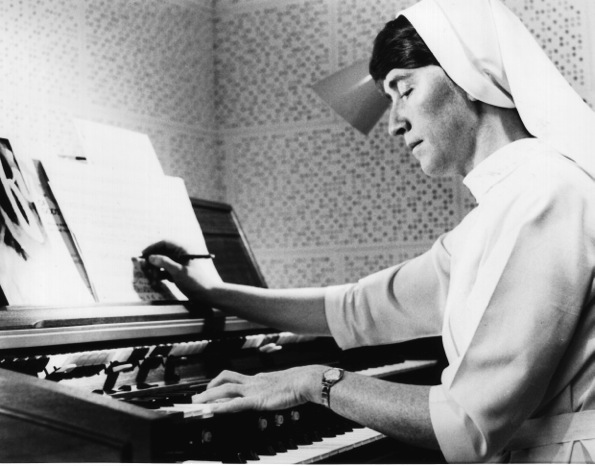
Sister Irene O’Connor: I don’t think there’s any one music or any one answer to anything. I think it’s a matter of different likes and dislikes and different characters and different needs, and especially now in Australia, different cultures and things. So, I would like to see where it’s possible. I know it’s not possible, but for example, with the Catholic Church, if we had different masses geared to different maybe age groups or different likes and different dislikes. So even if they had a mass for children, something very, very simple with one little reading and simplified on their hymns, but it’s sort of very difficult to cater at one mass for everybody. So, I would say three masses. But say which one is going to be what style it is and I think that could help a lot and it would group together the different type of people where they could share more rather than someone sort of being a bit… anti-Gregorian chant and waiting for something really on the folk style or something like that, putting up with one and then the other putting up with the other. And it should, that’s not what prayer or worship’s about, it’s something that should bring each person closer to God and it can only do that if it’s meaningful to you.
Jordie Kilby: Some thoughts there from Sister Irene O’Connor, someone who’s enjoyed a long career helping people find meaning in their lives. And one very powerful way in which she’s done that is through her music. I think you can get a sense pretty quickly, even from that short grab, that Sister Irene is someone with ideas, someone who’s looking to push the boundaries of what she knows and then watch what happens. This is the fascinating story of Sister Irene O’Connor and the creation of her 1976 album, Fire of God’s Love. But it wasn’t easy tracking them down…..
Introducing Sister Irene O’Connor and Sister Marimil Lobregat
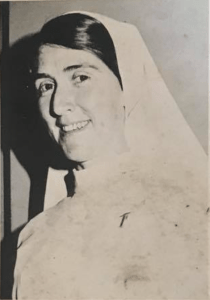
Sister Marimil Lobregat: I hadn’t heard of anyone talking about that record, that’s why I was so surprised when I heard from you. Yeah, I had forgotten about it completely. Yeah, I suppose I have so many other exciting things, that I didn’t give it much thought.
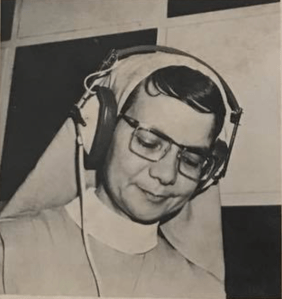
Jordie Kilby: That is Sister Marimil Lobregat. You see, there are actually two stars in this story. Marimil was the engineer and in many ways the producer on the recording. She’s credited on the record. I found Maramil via a small ad for courses offered by the University of the Third Age in Sydney and it turns out that her talents go way beyond her involvement in this record.
Sister Marimil Lobregat: Well I’m very involved mostly at Calvary Hospice. I work with a dying. I massage, I develop creative massage programs for people who are very ill and I’m very involved with the teaching of classes of Tai-chi, especially Qigong, as relevant to life though, not just as a form of oriental practice, but I’m attaching the spirituality of the body with it. I have another ministry, but it’s on a very quiet side. I work with the prostitutes. I also give workshops. I used to give weekend retreats on the spirituality of the body using, again, Qigong. I don’t think the bishops would like to hear that very much, though. Because it’s not, it doesn’t sound Catholic. But see, I’m not here to please the bishops. I’m here to do a mission, whatever I see is fruitful and beneficial for those who need it most.
Jordie Kilby: As you can probably tell, Sister Marimil is another soul with plenty of ideas about how to help people in whatever way she can. In fact, when I rang the lady who ran the uni course to see if she could put me in touch with her, she said she’d never heard that she’d made a record, but she wasn’t at all surprised. “She is an amazing woman”, I was told. Wait till you speak with her. You’ll see what I mean. So she gave me her details. And over the course of that weekend, I exchanged emails with Sister Marimel. She hadn’t spoken to Sister Irene for years, but still had her contact details. And by the end of the weekend, we’d spoken to both. And the tale of two nuns who created fire in their spare time on a series of Sunday afternoons in Point Piper and Homebush in the mid-1970s began to emerge.
Sister Irene O’Connor: So you just want me to talk about how music, the music thing started with me?
Jordie Kilby: Yeah, music in your life. We spoke yesterday with Marimel.
Sister Irene O’Connor: You did? All right, yeah. And she told you about her recording and everything?
Jordie Kilby: Yeah, she told us about the recording from her perspective. And a little bit about your friendship and your relationship and how long you’ve known one another and where you met.
Two Sisters With A Mission
Sister Marimil Lobregat: We first met in Singapore. As you know, I come from the Philippines. My first mission was with the lepers in the Philippines, in Tara Leprosarium. And after six or seven years there, I was sent to Indonesia. But to get established there, the missions there, I had to have a permanent residency. And it was very difficult at that time, because it was during the time of President Sukarno. So anyway, that’s how I was sent to Singapore first, for the sisters there to work on the visa, for Indonesia. And that’s where I met Sister Irene. Irene was already there. I think she was teaching the pre-kindergarten level. And while waiting there, I was asked to teach the kindergarten class. That’s where I met Irene, yes.
Sister Irene O’Connor: She didn’t do any music or anything with me then. I was, I don’t know whether she, I can’t remember if she passed through before I did the first LP with Phillips. She might have, she wouldn’t have even known that you know I was doing music but you know, being Singapore we had a lot of sisters coming. They’d arrive at Singapore from different countries and then they’d go to Indonesia or New Guinea or different places like that and they used to stay a day or two for a while in Singapore and that’s how I met Maramil. But [later] we, we ended up in Sydney in the same community.
Sister Marimil Lobregat: I missioned here to Sydney, Australia, to work at the Catholic Audio Visual Centre as a sound and visual technician, because I had experience in that. So eventually, Irene also was sent to Sydney, and we met again here.
God Is Dwelling In My Heart
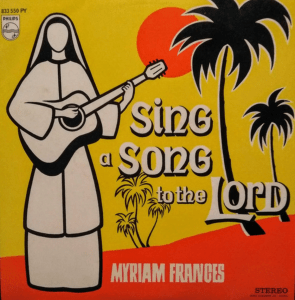
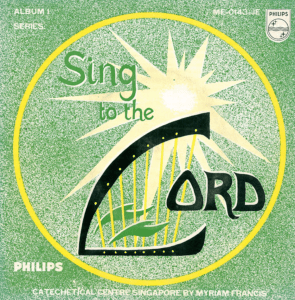
Sister Irene O’Connor: I had already recorded with Phillips a few years before – Sing a Song to the Lord – and that was an LP with 10 songs and I did it under a different name. I did it under the name of Myriam Frances and nobody knew it was me in Singapore except the Phillips people. And I didn’t do it originally as a big LP, I did it on four little EP, extended play records, and it had four songs on each. So when it got to three, everybody liked it and it was very successful in Singapore, Philips in Holland took it and put it all together as an LP and it came back in Singapore as that and that was released over in Australia as well. That was the biggest thing for me, I think, was the one I did is called God is Dwelling in My Heart. That went all over the world. I was away 15 years, and I came back to Sydney and I went to mass one day down at St. Patrick’s, I think it’s Churchill, it’s down near Circular Quay. And it was just a midday mass, or 10 o’clock, I can’t remember. I opened the door and I walked in and there were all these schoolchildren there from the school nearby and they had guitars and, you won’t believe it, I got the shock of my life, they were singing loud through the speakers, God is Dwelling in My Heart.
Fire Of God’s Love
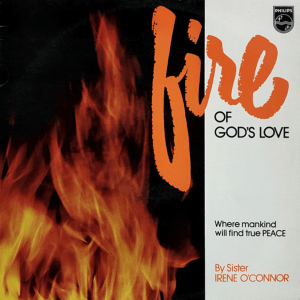
Sister Marimil Lobregat: Years after, as I said, for me it was thirteen or fourteen years after I was sent here to Sydney, Australia. And we were both living at the convent at Point Piper. Every day I would go to work very often, including weekends, to Homebush, because that’s where the Catholic Holy Visual Center was established. So, because I was in that area of recording and visuals too, she asked me one time, you know, if she could, she was ready to record another record. I wasn’t doing records then, but anyway, we were given the use, allowed to use the studio at Homebush on weekends, like on Sundays, which is when we went several Sundays to record the tracks that are now in the record file.
Sister Irene O’Connor: It is a bit of a unique record in that sense, you’d never think that two nuns, I mean, if you said two women it’s bad enough putting it out at that time, but if you say two nuns, it was a bit of a surprise. But we were both more or less into that sort of creative sort of way of spreading, you know, God’s Christ’s message of love. I do it with the music and the songs and things like that. And she… mainly she does a lot of lovely tai chi and things and I think she’s made videos and all of them. So anyway, we’re a bit different.
Sister Marimil Lobregat: Maybe if I knew what I was getting into, you know, but at that time, you know, you’re young, you’re hopeful. It was the two of us. She did all the music, all the recording. We did it at Point Piper. We had a kind of a little soundproof room over there. So, she recorded it there. I recorded it for her while she played the music, the background, the drums, whatever. I recorded it into the Revox. Then we brought that recording, the tape, to Homebush. I played it from the sound room where I had the master mixer. And Irene was over at the studio, which was also soundproof with the earphones in order to hear the music and sing into it. And also, at that time we didn’t have separate tracks. It was all in one track.
Sister Irene O‘Connor: I had to be the choir and the orchestra. And I just played it, I found, pulled one out today and I thought, I must listen to that and remember what I did on it because I thought I might be talking to you today. And I thought, I’d better see what’s on it. And I was quite surprised that I could hear myself doing… See, I had an organ when I came back here and had a little organ, then I had a guitar. I did all the harmonies too. It’s like, sounds like a lot of people singing in some places, but it’s all me singing different times, adding one. And that was the great thing that Marimil did. She sort of… well, put it all together, all together in one thing and I was like the orchestra and the choir and I don’t know what you’d call her, the engineer and the conductor or something.
Sister Marimil Lobregat: I remember that we would go early in the morning and leave late at night. We had to repeat the track on account of the fact that it wasn’t, like we couldn’t get the proper echo, the proper reverb for the voice, for the music. So, I had to bounce the volume with the recording, you know, and that took many repeats before we were more or less satisfied with it.
Sister Irene O’Connor: The one funny thing that I remember was I wanted the one called Fire. That was going to be very special. And I wanted it to start off like mysteriously, like in a big cathedral or in a cave or something. So, I wanted this reverb sound, but where she [Sister Marimil] worked, they didn’t have any reverb because it’s only radio sort of stuff, you know. And I didn’t know what we’d do. And then I went into the bathroom one time and we said we’d try in there. I said, “this is echoey, this might do.” And it was going to be all right. We had a great big, long, long lead from where her recording thing was, and it went round out one room and into the other. I started to sing through and it was sounding fine. I had earphones on, I don’t know how I connected up to what was going on, but the trouble was the dog next door in the house started to bark, and he got recorded while we were doing it, so we had to get rid of that. I still wanted this reverberation, so I got a little reverb for $20, I remember the price and all of that, that would go in an organ. And I don’t know what Marimil did, but somehow, with her great engineering idea, she somehow attached it, and we used a bit of a reverb of that from there.
Jordie Kilby: Can we ask you about a couple of the other songs on the album? Keshukoran.
Sister Irene O’Connor: Ah yes, I love that one because, when we were in Singapore I taught in kindergarten, and we had a gardener. I can’t remember his name, isn’t that terrible, but he was a lovely man. And his family lived down, just down from us and they were Muslim. And I said, I wanted to write something in the Malay language, like, you know, to share. And I could see I had to be careful. I would ask him how to say I wanted to praise God. I wanted to check with him, I knew a little bit of Malay but not much, and they would say “Allah, Allah”. But he said “oh no, you don’t say that, you’ve got to say Tuhan.” Tuhan means Lord, and I think it’s because, like, Allah is too sacred for me to be talking about. But it was lovely and that’s why the lyrics mean, “O Lord, the Creator, we adore you, the Almighty.” All the verses are very simply put, I just asked him how to say birds, and paddy fields, and rivers, checked it all up, and for the sun and the moon and the stars. So, you just hear this, all these little phrases. So it’s saying, “for the sun, let us give thanks to the Lord. For the rivers and the seas, let us give thanks to the Lord, and for the paddy fields….” And that’s all it is. It’s very simple. But I thought, I put in the little bongo things, and I remember playing that when I recorded it. Here you see, I played the guitar, and when you hear a bass on it, I think it’s just me with my foot playing the bass foot pedals of the organ. And it goes boom ba boom. And it sounds as though I’m playing a bass drum or something, but I’m not, so… It’s all a bit of trickery, but I’m doing it all.
Jordie Kilby: Who did you think would buy the record then?
Sister Marimil Lobregat: Well, we didn’t think of that, you know. I remember we went a couple of times, Irene and I – because it was a private thing you know and she didn’t have any agent or distributor or anything – I remember we went to Woolworth’s and we approached one of the salesperson there and he kept promising, yes, he was going to talk to the manager to sell it there. You know, Woolworth’s of Town Hall, the corner (in Sydney). Yep. Yeah. But he never got to the manager or anything. I don’t know what the plan was. Perhaps the plan was to go to Catholic schools or shops or something, but I don’t remember exactly what… I just… see, after I did all that recording, little by little, I weaned out of… Irene’s recording projects.
Sister Irene O’Connor: I lived up in the mountains, up for a while there, and I composed a lot of other things. A musical, which I did on the four-track, and that even came out on the CD. I got someone to edit that for me, put it all together. I just did all the playing and all the singing and the voices, but I didn’t even know how to boil it down, as I call it, to stereo. That was a musical for St. Francis. Just had a call from a lady the day last night or the night before saying, she loved the one on “praise in the morning praise in the evening”, it’s called, and it’s all the Psalms and canticles. So, other people wouldn’t be interested in that you know they like more like the the jazzy things or the Calypso and South American sort of beats. I like those things and I still love love that kind of music but I feel the type of music I’m doing, I want to do now, and I have been doing, is meditation music, very quiet, gentle music, just to be in the presence, to pray sort of what I call silent prayer.
If you enjoyed this story please consider sharing it with a friend and subscribing so can receive future posts.
After being a difficult record to find for many years, Fire of God’s Love recently received and official reissue. If you’ve enjoyed this story and do not own a copy of the album please consider ordering a copy here.
This interview was originally published as part of the RareCollections podcast.
 Sonic Archaeology